I’m writing this the day after Anthropic’s IPO. I’m sitting on my couch, watching the news, with a sleeping dog on one side of me and a coffee on the other.
The past week has been full of major tech outages. Depending on which talking head you listen to, the cause has been everything from a sophisticated threat actor to an engineer unplugging the wrong cable.
Or maybe… AI.
What strikes me most is that nobody seems to be interviewing engineers.
Every engineer I’ve spoken to has said roughly the same thing:
“Someone messed up the release.”
I think AI is becoming the digital boogeyman of the 2020s.
We’ve gone from safety researchers leaving the industry to “live in the woods” to headlines blaming AI for massive layoffs. At the same time, AI is proving incredibly expensive for organizations. Bryan Catanzaro, Nvidia’s VP of Applied Deep Learning, summed it up well when he told Axios:
“For my team, the cost of compute is far beyond the costs of the employees.”
So here’s the other side of the story.
AI is a tool.
I love a good analogy, so let’s lean into one.
Imagine you’re renovating a room in your house. Traditionally, you either do it yourself or hire a contractor. Now imagine someone invents a tool that makes hanging drywall dramatically easier. Suddenly, it’s accessible to almost anyone. After watching a couple of YouTube videos, I might decide, “I can probably do that.”
(My wife usually gets nervous when I say those words.)
That new tool absolutely takes some customers away from contractors. But it doesn’t magically make me a skilled builder. I’ll still make mistakes, probably redo parts of the job, and there’s a decent chance I’ll end up hiring someone to fix my work anyway.
As it turns out, my wife is usually right.
The point isn’t that the tool wrecked my house. The point is that the tool made skilled people even more effective.
The same is true of AI.
In the hands of someone who understands their craft, AI increases productivity, accelerates experimentation, and often improves quality. In the hands of someone who doesn’t, it simply helps them make mistakes faster.
That’s why successful AI adoption isn’t really about the technology.
It’s about people.
When leaders introduce AI into an engineering organization, success depends on whether the humans in the loop trust the tools and believe they genuinely improve their work. Trust isn’t built by mandates. It’s built through experience.
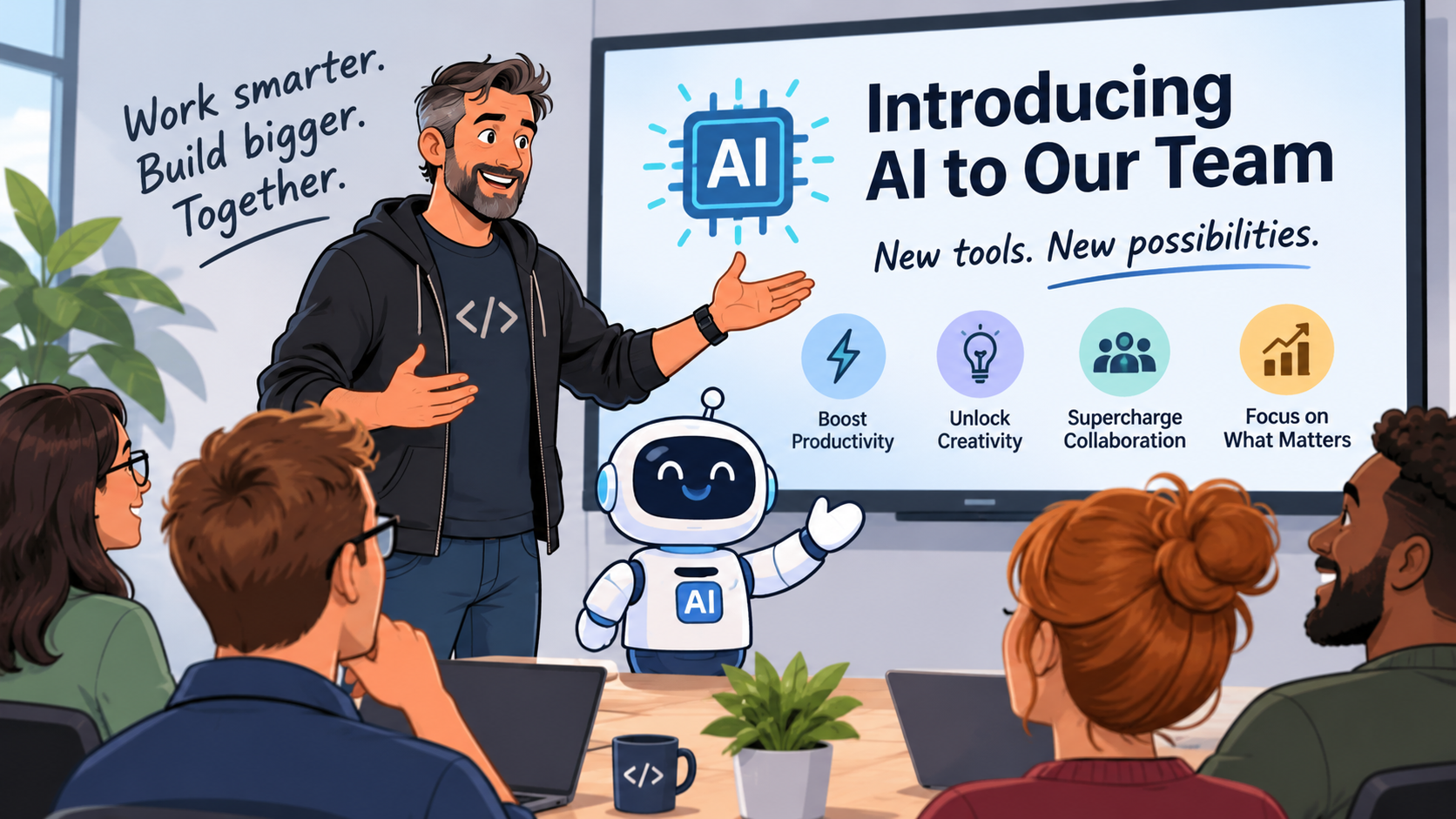
When I introduced AI tools to my team, we took a deliberate approach. We aligned with other engineering leaders first so our messaging and expectations were consistent. We started by integrating AI into our CI/CD pipeline through automated code review, where it could provide value without disrupting individual workflows.
Next, we offered engineers Copilot and worked with them one-on-one to experiment with it in their IDEs. I also took on a project myself using an AI-first development approach so I could understand both the strengths and the frustrations before asking others to do the same. Finally, we held informal brown bag sessions where engineers shared what they’d learned, what worked, and what didn’t.
None of this was about forcing adoption.
It was about building confidence.
Trying to impose AI on people is usually a waste of time, especially when fear and job insecurity are already in the room. Real adoption happens through collaboration. When teams help evaluate, shape, and integrate new tools into their own workflows, anxiety is gradually replaced by confidence.
AI shouldn’t replace expertise.
It should amplify it.
That’s how you build trust. And that’s how you unlock the real potential of both the technology and the people using it.